

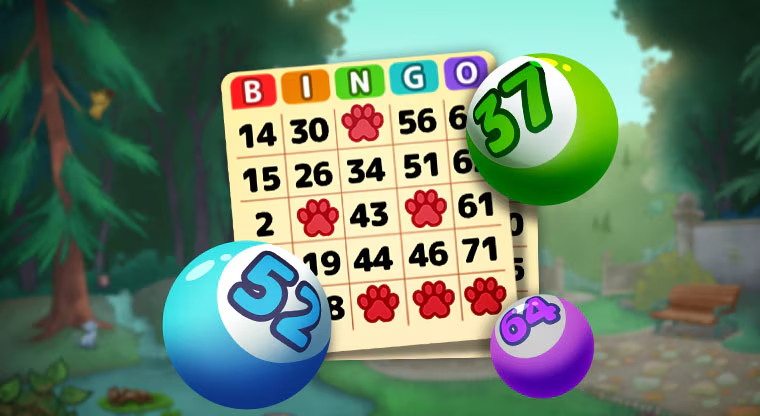
The transition of traditional bingo halls into the digital space revolutionized the reach and pacing of the game. While the core social appeal and the fundamental mechanics of marking tickets remain intact, digital platforms introduced completely new financial structures. Among these structural innovations, the progressive jackpot stands out as the most compelling tool for accelerating engagement.
Unlike a fixed prize pool, which features a rigid, predetermined payout ceiling for every individual round, a progressive prize operates on a dynamic expansion model. The financial ceiling grows continuously until a specific, highly demanding mathematical condition is fulfilled. Understanding the mechanical architecture, computational algorithms, and strict rules governing these jackpots allows players to view the game through a lens of objective reality rather than emotional expectation.
The Core Financial Framework of a Progressive Pool
To understand why a progressive prize can scale into tens of thousands of dollars, you must look closely at how the operational ecosystem is financed. The expanding pool relies entirely on a continuous accumulation mechanism built into the ticket purchasing system.
When you purchase a virtual ticket in a progressive room, the system does not direct the total ticket cost into the standard game prize pool. Instead, the operational software splits the capital into specific percentages. A primary portion goes toward funding the standard line and full-house awards for that immediate game. A smaller secondary portion, typically ranging from two to five percent of the overall ticket value, is siphoned off and routed directly into the main progressive vault.
Because major digital bingo networks host thousands of active players simultaneously across multiple rooms, these tiny, high-frequency contributions add up fast. The total prize ticker updates in real time on the user dashboard, ticking upward with every single ticket purchase completed across the network.
The Mathematical Boundary: The Ball Count Constraint
The central mechanism that keeps progressive jackpots rare and highly valuable is the ball count threshold. In a standard bingo game, the round continues until someone completely fills their card, regardless of how many numbers must be called to reach that state. A player will eventually hit a full house, even if it requires drawing seventy out of seventy-five balls.
A progressive award operates under a completely different strict criteria. To claim the grand prize, a player must achieve a full house within a fixed, highly limited number of ball calls.
-
The Statistical Hurdle: In a standard seventy-five-ball game, a platform might declare that the progressive prize only triggers if a player achieves a full house in forty-eight calls or fewer.
-
The Probability Factor: The probability of completing a full house on exactly the forty-eighth ball is exceptionally low. If the game passes the forty-eighth call and no player has completed their card, the progressive window closes for that specific round. The standard game continues for the regular full-house prize, while the progressive pool remains untouched, carrying over to collect more funds in the next round.
Network Architecture: Local versus Networked Jackpots
Not all progressive bingo games utilize the same scope of infrastructure. Platforms deploy these systems across two distinct structural categories, which alter both the scaling speed of the prize and the competitive landscape.
1. Standalone Local Progressive Rooms
A local progressive pool is completely confined to a single, specific digital room hosted by one particular operator. Only the ticket purchases made by players sitting within that digital room contribute to the funding pool. Consequently, these jackpots expand at a slower, predictable pace. The advantage for the player is a significantly smaller competitive field, meaning you are only competing against a localized group of users for the trigger state.
2. Network-Wide Linked Pools
Networked progressives pool resources across dozens of entirely separate casino and bingo websites that share the same underlying software provider. A player buying a card on one platform is contributing to, and competing for, the exact same pool as a player logged in on a completely different website miles away. These pools scale at an explosive rate due to the massive volume of continuous micro-contributions, creating large prize pools but presenting a significantly larger pool of global competitors.
The Re-Seeding Mechanism and Capital Security
A common point of confusion regards what happens to the progressive display immediately after a player beats the odds and claims the pool. The display ticker does not drop down to zero dollars. If the value fell to zero, there would be zero commercial incentive for players to join the subsequent round, as the potential return would not justify the engagement.
To prevent this drop, platforms implement a re-seeding mechanism. When the progressive jackpot triggers, the host platform resets the prize display to a guaranteed minimum baseline amount, which could be set at one thousand, five hundred, or ten thousand dollars depending on the network stakes.
This baseline seed is financed by a tertiary structural slice taken from historical ticket sales, known as the reserve fund. While the primary progressive bucket expands visibly on screen, a hidden secondary bucket builds up silently in the background specifically to fund the next seed. This setup guarantees that the room remains highly competitive and financially attractive even one minute after a historic win.
Game Variations and Payout Distributions
The configuration of a progressive prize shifts significantly based on the specific variant of bingo being executed. The two most prominent variations feature different structural approaches to the final payout mechanism.
The Ninety-Ball Tiered Approach
In traditional ninety-ball games played on a three-by-nine grid, the progressive mechanism often demands filling all fifteen numbers on a ticket within a tight boundary, such as thirty-two calls. Because this variant features different intermediate prize steps, like completing a single horizontal line or two horizontal lines, platforms occasionally design multi-tiered progressive pools where clearing lower lines under hyper-strict call limits triggers a small percentage of the total progressive vault.
The Seventy-Five-Ball Pattern System
Seventy-five-ball progressive games are played on a five-by-five grid and allow for broader creativity in trigger conditions. While many require a standard coverall where all twenty-four active squares are filled, others base the progressive trigger on completing highly complex geometric shapes, such as an outer border frame or a perfect double-diagonal cross shape, within a predetermined, strict ball count window.
Frequently Asked Questions
Does buying multiple bingo tickets in a single progressive game round elevate my individual statistical odds of triggering the jackpot?
Yes. Because each individual bingo ticket features a distinct, unique matrix of random numbers, every extra card you bring into the round adds a new mathematical vector to capture the required numbers. If the room demands a full house within forty-five calls, holding twenty cards gives you twenty independent chances to hit that exact coverage profile, whereas holding a single card limits you to one lone statistical sequence.
Can a progressive bingo jackpot be shared simultaneously by two or more players?
Yes. If two or more independent players complete their card matrices on the exact same called ball within the mandatory call limit boundary, the platform protocols dictate that the progressive pool is split equally among the winners. The automated ledger divides the total accrued value evenly, distributes the funds to the respective player accounts, and then triggers the standard re-seeding protocol.
Are progressive bingo algorithms protected against system lag or connectivity drops?
All progressive math is handled entirely on the central secure network servers of the software provider, not on the user local phone or computer. The moment a ball is generated by the server, the system checks every single active ticket in the database. If a ticket hits the jackpot criteria, the win is recorded instantly on the secure ledger, ensuring that a user experiencing an internet drop still receives their full payout automatically.
Why do some progressive rooms enforce a minimum ticket price threshold to qualify for the main pool?
Platforms establish minimum ticket value thresholds to protect the mathematical balance of the contribution model. If a player could win a massive networked prize by risking a single penny, it would undermine the financial inputs provided by players buying standard or premium tickets. Enforcing a baseline minimum ticket cost ensures that every competitor has contributed a fair, proportional share to the expanding vault.
What is the mechanical difference between a progressive jackpot and a community jackpot in online bingo?
A standard progressive jackpot pays the total accumulated pool exclusively to the individual player who holds the winning card configuration. A community jackpot structures the payout as a shared distribution. When the trigger condition is met, the winning cardholder receives a major percentage of the vault, while the remaining balance is divided proportionally among all other active players who bought tickets for that specific round.
How often do independent regulatory testing groups audit progressive bingo systems?
Regulated platforms undergo strict, recurring audits by independent software testing authorities on a monthly or quarterly basis. These compliance groups inspect the random number generator engines, verify the server logs, and audit the precise allocation of ticket percentages to ensure the progressive pooling mechanism operates with absolute mathematical transparency and in total alignment with local consumer protection laws.